Most knitting and crochet rests on a short list of stitches repeated many times. Once casting on, the knit stitch, the purl stitch, and the single crochet feel familiar in the hands, a large share of beginner patterns becomes readable. This note describes each one in plain terms and points out the habits that keep a piece even.

Casting on
Casting on places the first row of loops on the needle and sets the edge of the work. The long-tail cast-on is a common starting point because it produces a tidy, moderately stretchy edge suitable for scarves and dishcloths. Leave a tail roughly three to four times the planned width of the piece before you begin, so you do not run short partway through.
- Keep the loops loose enough to slide along the needle without bunching.
- Count the cast-on stitches twice before the first row; a miscount here follows you through the whole piece.
- If the edge pulls tight, cast on over two needles held together, then slip one out.
The knit stitch
The knit stitch is the building block of nearly every knitted fabric. Worked every row, it creates garter stitch, a ridged, reversible fabric that lies flat and is forgiving for a first project. The sequence is consistent: insert the right needle into the front of the loop, wrap the yarn, draw a new loop through, and slip the old loop off.
The purl stitch
The purl stitch is the reverse of the knit stitch; the working yarn sits in front and the new loop is drawn toward you. Alternating knit and purl across rows produces stockinette, the smooth fabric familiar from many sweaters. Stockinette curls at the edges, which is normal and is usually managed with a border of garter or ribbing.
Tension note
Uneven tension is the most common beginner frustration. Rather than forcing each stitch tight, aim for a steady rhythm and a consistent way of holding the yarn. Tension tends to even out with practice across a few rows, so it is worth finishing a small swatch before judging it.
The single crochet
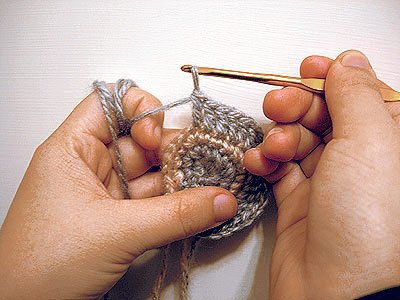
In crochet, the single crochet (UK: double crochet) is the short, dense stitch underpinning many beginner pieces. After a foundation chain, insert the hook into a stitch, draw up a loop so two loops sit on the hook, yarn over, and pull through both. Worked in rows it makes a firm fabric; worked in the round it forms the base of coasters and small bags.
A short practice plan
- Cast on 20 stitches and work garter stitch until the piece is square. This trains the knit stitch and the cast-on edge.
- Cast on again and alternate knit and purl rows to see stockinette and its curl.
- Make a foundation chain and work several rows of single crochet to compare the two crafts side by side.
Keeping these swatches is useful: labelled with the yarn and needle or hook size, they become a personal reference for future projects.